


From Clinical Dilemmas to Strategies for Improving Oocyte Competence
One of the biggest hurdles in the reproductive medicine field today is the condition known as diminished ovarian reserve (DOR). As soon as a woman is diagnosed with this, the first thing she is usually concerned with is the likelihood of a successful fertility attempt from her diminished ovarian reserve. In the past, fewer eggs meant a bad prognosis or a dead end.
One of the key factors that Little Angel IVF strives to understand when dealing with low egg counts is the fact that they aren’t necessarily regarded as a failure if they are present. New evidence-based protocols not only analyze the number of eggs that can be gathered, but also the health and developmental potential of each egg. Reproductive specialists are leading the way in creating new avenues of successful pregnancy for women with limited ovarian reserve.
What is Diminished Ovarian Reserve?
Diminished ovarian reserve, or DOR, occurs when a woman’s egg count and quality have significantly decreased from typical for her age. It affects 10% to 24% of women undergoing fertility treatment.
Unlike menopause, which is the complete end of ovarian function, women with DOR still ovulate and have regular periods.
Causes and Symptoms
- Causes: The primary cause is ageing, with genetic changes (e.g., Fragile X) and autoimmune diseases, prior abnormal surgery in the pelvis, cancer treatments, and endometriosis also playing a role in the development of DOR.
- Symptoms: No significant clinical signs are seen. Periods are not disrupted but may be shorter (e.g., dropping from 28 days to 24 days), which may be a precursor to a more rapid follicular phase.
Why DOR Presents Clinical Challenges
Clinical Reality vs. Patient Anxiety
Good clinical judgement is essential for a poor ovarian response. In women with severe diminished ovarian reserve (DOR) according to either the Bologna or POSEIDON criteria, a lower number (3-5 oocytes) is likely from normal IVF stimulation. With these low figures, patients often feel tremendous anxiety and think that the diagnosis means that their only chance of parenthood has passed.
Redefining the Strategy
The treatment strategy is changed due to low reserve, not the outcome – since only one competent oocyte is required for a healthy pregnancy.
Dr. Mona Dahiya explains that based upon her expertise, a low AMH shouldn’t be a measure of a woman’s chance of experiencing motherhood, but rather a parameter to guide treatment planning. In modern care, it is not about the quantity of eggs produced but the potential their development has to reach its maximum.
Rethinking Success in DOR
Clinics have traditionally evaluated themselves on production of eggs alone. This measure sets unachievable expectations and undue despair for those who have a low ovarian reserve.
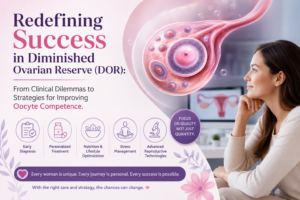
Modern reproductive medicine reverses this trend. Current clinical management will focus on patient-centred outcomes and not on high egg production; this will include the production of high-quality chromosomally normal (euploid) embryos and the maximisation of the live-birth rate per transfer according to ESHRE (European Society of Human Reproduction and Embryology) guidelines.
Understanding Oocyte Competence
What is Oocyte Competence?
Oocyte Competence is the ability of an egg cell to grow and embed itself in the wall of the uterus. This will require two deep degrees of maturity going hand-in-hand:
- Nuclear Maturity: Correct arrangement and separation of chromosomes.
- Cytoplasmic Maturity: Normal accumulation of proteins, RNA, and functional mitochondria in the egg.
The Role of Mitochondria and Age
The mitochondria are the “powerhouse” of the egg cells. As stated in The Lancet and Nature Reviews Urology, the study confirms that with age, there are mitochondrial mutations and increased oxidative stress, which lead to the incompetence of eggs. The mitochondrial condition plays an important role in successful development of the early embryo, since it requires all the energy from maternal mitochondria till the blastocyst stage.
However, if the egg’s cytoplasmic and mitochondrial equipment is working properly, even a small stock of oocytes can give rise to very competent embryos for full-term pregnancy.
Evidence-Based Strategies for Improving Oocyte Competence
1. Advanced Stimulation Protocols
- Protocol Selection: Including only two agonist days of the flare protocol instead of many agonist days; this will not oversuppress the ovaries and will be better for using the natural pulses of FSH (Follicle Stimulating Hormone).
- Mild Stimulation: The high dose (more than 450 IU/day) of the medication does not affect the outcome positively. Less stress and fewer cancellations result in a similar quality of high-quality eggs with milder protocols.
- DuoStim: If eggs are collected twice within a cycle, in the follicular and luteal phases, then more competent oocytes are accumulated, thereby reducing cycle time to pregnancy.
- Dual Triggers: Egg maturity is optimized (affects immature yields) with a combination of the GnRH agonist and low-dose hCG.
2. Laboratory Optimization
With the limited eggs, a protected laboratory environment is required. Advanced Embryology techniques use specialized oxygen levels, media, and quality time-lapse live viewing that avoid exposure of very delicate embryo cultures.
Role of Nutrition and Supplements
1. Evidence-Based Supplements
- CoQ10 (Coenzyme Q10) [600 mg/day for 60 days]: Proven (JARG – Journal of Assisted Reproduction and Genetics) to improve high-quality embryo and retrieved oocyte rates via improved mitochondrial ATP (Adenosine Triphosphate) levels and decreased oxidative stress.
- DHEA (Dehydroepiandrosterone): No consistent information available (RBMO – Reproductive BioMedicine Online). The European Society of Human Reproduction and Embryology (ESHRE) and the American Society of Reproductive Medicine (ASRM) advise against routine use, but to adjust according to baseline androgen levels for each person.
- Antioxidants (Melatonin, Vitamin E): neutralize ROS (Reactive Oxygen Species) to protect the integrity of the structure of the egg.
- Vitamin D: correcting the deficiency optimizes AMH (Anti-Müllerian Hormone) receptor sensitivity and receptivity of the endometrium.
2. Lifestyle Interventions
- Antioxidant Diet: Safeguards follicles from damage to cells.
- Stress Management: Decreases the effect of cortisol on the ovary’s function.
- Toxin Avoidance: By removing cigarette smoke, accelerated follicular depletion is avoided.
Ovarian Reserve Testing and Outcomes
A full assessment of a patient’s reproductive status is dependent on the proper use of several important markers.
1. Key Diagnostic Biomarkers
- Anti-Müllerian hormone (AMH): According to the ASRM (American Society of Reproductive Medicine), AMH is a good predictor of ovarian responsiveness to stimulation, but not a good predictor of live birth or natural pregnancy outcomes.
- Antral Follicle Count (AFC): This measure is done using transvaginal ultrasound during the early follicular phase and is based on the number of resting follicles that can be seen. If less than 5-7, this suggests a smaller reserve was present.
- Basal FSH (Follicle-Stimulating Hormone) & Estradiol: High FSH levels at the beginning of the cycle reflect low functional reserve.
2. Clinical Consensus
Guidelines from the Indian Society for Assisted Reproduction (ISAR) and the Federation of Obstetric and Gynaecological Societies of India (FOGSI) note that ovarian reserve testing gives an idea of how the ovaries will react to fertility medications, rather than whether a woman naturally conceives and carries a fetus to term. It would be a needless heartache to base these figures on as an absolute prediction of pregnancy.
Future of DOR Management
Reproductive endocrinology is still a constantly changing field. The International Federation of Gynecology and Obstetrics (FIGO) provides an often-cited means of noting progress in reproductive medicine, which is tailored to the needs of individuals. With the help of artificial intelligence (AI) algorithms, the embryo’s time-lapse cellulisation can now be subjected to analysis, and embryologists are able to learn about the quality of the most viable embryos with very high accuracy.
Oocyte quality is under investigation before fertilization, with novel markers being explored in follicular fluid, including certain specific microRNA expressions. Furthermore, new ideas around ovarian rejuvenation procedures are continuously being researched, such as injecting a patient’s own platelet-rich plasma into the ovary, and serve as a possible treatment in a patient’s future if her reserves are extremely low.
Conclusion
A diagnosis of low ovarian reserve alters the road to parenthood but does not end it. Historically, the diminished ovarian reserve success rate has been of prime importance based on the number of eggs, and now a more comprehensive understanding is shifting to the understanding of the competence of the eggs, individualising stimulation protocols, and the advanced care of the egg in the laboratory.
Dr. Mona Dahiya’s approach at Little Angel IVF centers on the idea that, with a tailored approach and adequate and accurate medical interventions at the right time, quantitative restrictions can be overcome. By focusing on the health of each cell and using personalized treatment techniques, many women with low ovarian reserves can successfully become mothers.
Frequently Asked Questions (FAQs)
- What is diminished ovarian reserve (DOR), and can I still get pregnant?
DOR is when you don’t have as many eggs as you should have at your age. Yes, it is possible to conceive naturally or using fertility treatments if you have good quality eggs left.
- Does diminished ovarian reserve affect egg quality or just the number of eggs?
The main effect of DOR is a decrease in egg numbers rather than a decrease in egg quality. A woman’s age will be the most important factor in determining the quality of her eggs (younger women with DOR may still have good eggs).
- How can oocyte competence be improved in women with DOR?
Specialized individualized low-dose ovarian stimulation protocol, cellular energy supplements (CoQ10) and targeted lifestyle changes during the 90-day egg production period help determine the quality of eggs.
- What tests are used to diagnose diminished ovarian reserve?
The diagnosis of DOR is made via a blood test which measures Anti-Müllerian Hormone (AMH), an Ultrasound Scan to see how many Antral Follicles (AFC) are present, and a blood test on Day 3 which measures Follicle-Stimulating Hormone (FSH).
- Is IVF successful for women with diminished ovarian reserve?
Yes. In DOR, IVF results are not dependent on fetal egg count, but depend more on the quality of the egg and custom treatment. It only takes one healthy embryo to achieve a pregnancy.